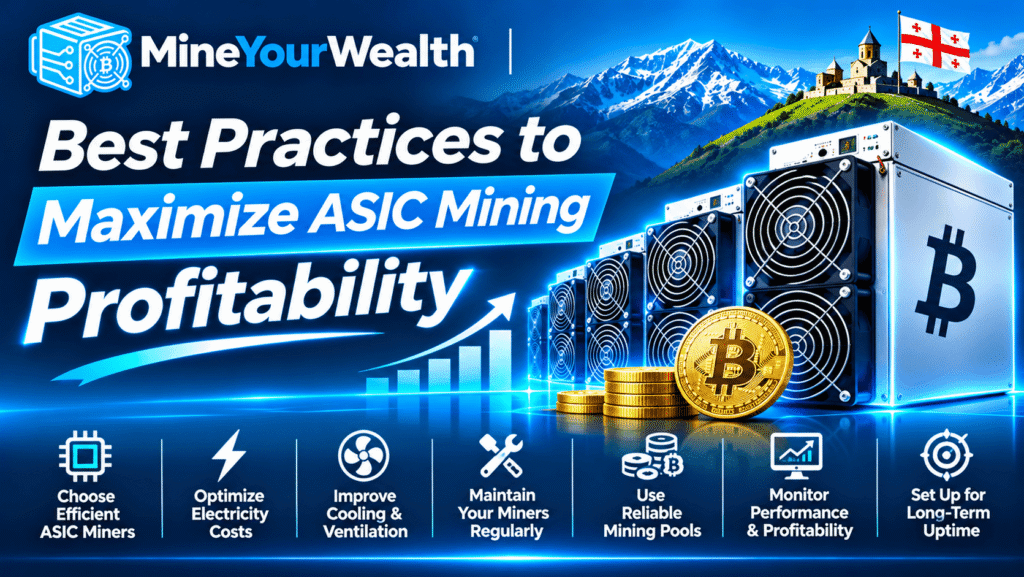
Best Practices to Maximize ASIC Mining Profitability
Last updated: 19 November 2026. Network data, Bitcoin prices and electricity tariffs change often; every time-sensitive figure below is dated and linked to its source.
Buying the most powerful ASIC miner on the market does not, by itself, make a mining operation profitable. What decides the outcome is the gap between what a machine earns and what it costs to run, and that gap depends on hardware efficiency, electricity price, network difficulty, the Bitcoin price, pool fees, cooling and uptime. This guide walks through the best practices to maximize ASIC mining profitability, with worked calculations and a dedicated section on ASIC mining profitability in Georgia (the country, საქართველო) based on the tariffs currently approved by the regulator, GNERC.
Understanding ASIC Mining Profitability
An ASIC (application-specific integrated circuit) miner is built to run one hashing algorithm, such as SHA-256 for Bitcoin or Scrypt for Litecoin and Dogecoin. Its profitability is the money left after every cost of producing hashrate has been paid.
Seven factors drive that result:
- Hardware efficiency – how much electricity the miner needs per unit of hashrate (J/TH for SHA-256).
- Electricity costs – usually the largest ongoing expense.
- Network difficulty – rises and falls with total network hashrate, changing how much Bitcoin each terahash earns.
- Cryptocurrency market prices – mining revenue is paid in coins, but most costs are paid in lari or dollars.
- Mining pool fees – typically a percentage of rewards.
- Cooling and maintenance – fans, filters, coolant, repairs and the energy used by cooling equipment.
- Hardware acquisition costs – purchase price, shipping, customs, VAT and installation.
Gross revenue vs. net profit
Gross mining revenue is the value of the coins your miner earns before any costs. Net mining profit is what remains after electricity, pool fees, hosting, cooling and maintenance are deducted, and, over the life of the machine, after the hardware has paid for itself. A miner can show healthy gross revenue on a calculator and still lose money every day if electricity is expensive.
1. Choose an Energy-Efficient ASIC Miner
Efficiency is the single most important specification for long-term ASIC mining profitability, because it sets how much electricity each unit of revenue costs. When difficulty rises or prices fall, inefficient machines become unprofitable first.
The specifications that matter
- Hashrate – the miner’s computing output (TH/s for SHA-256, GH/s for Scrypt).
- Power consumption – wall power draw in watts.
- Energy efficiency – power divided by hashrate. For Bitcoin miners this is J/TH (joules per terahash); for Scrypt miners it is usually J/GH or J/MH. Lower is better.
Efficiency = Power (W) ÷ Hashrate (TH/s). An Antminer S21 Pro rated at 234 TH/s and 3,510 W works out to 3,510 ÷ 234 = 15 J/TH.
New vs. older-generation miners
Each new chip generation lowers J/TH. Bitmain’s current S23 family includes an air-cooled model at roughly 11 J/TH and a hydro-cooled model at roughly 9.5 J/TH, compared with 15 J/TH for the previous-generation S21 Pro. Older machines are cheaper to buy but cost more to run per terahash, so they only make sense where electricity is very cheap or where you need a low entry price and accept a shorter useful life.
Air, hydro and immersion cooling
- Air-cooled miners are the simplest to deploy but are loud (often around 75 dB) and depend on good airflow and dust control.
- Hydro-cooled miners circulate liquid through cold plates. They are typically more efficient and quieter, but need a coolant loop, pumps, a dry cooler and, often, 380–415 V three-phase power.
- Immersion miners sit in a tank of dielectric fluid, which removes heat effectively and keeps dust out, but requires tanks, fluid and specialist handling.
Compare efficiency, not hashrate alone
A bigger hashrate number only helps if the electricity behind it is affordable. Two machines with the same hashrate can have very different running costs. Always compare J/TH, then price per TH/s, then the infrastructure each machine requires. You can browse current SHA-256 hardware in the SHA-256 miner category or the full ASIC miners collection at Mine Your Wealth.
2. Optimize Electricity Costs
Electricity is paid every day the machine runs, so a small difference in tariff makes a large difference over a miner’s life. To reduce ASIC mining electricity costs:
- Choose the right tariff category. Household, small-business and higher-voltage commercial tariffs differ significantly. Use the category that legally applies to your connection and activity.
- Understand commercial vs. residential arrangements. A commercial mining operation should not be run on a household tariff.
- Compare suppliers and connection voltages where you have a choice. Higher-voltage connections usually carry lower per-kWh prices but require a substation or transformer.
- Negotiate where available. Very large consumers may be able to buy power directly on the market or through bilateral contracts instead of regulated retail tariffs.
- Monitor consumption with smart PDUs or sub-meters so you know the real draw at the wall.
- Reduce electrical losses with correctly sized cables, short runs, efficient PSUs and higher-voltage distribution.
- Use peak/off-peak pricing where your tariff offers it. Georgia’s regulated retail tariffs currently use flat per-kWh rates by category rather than time-of-use pricing, so check before planning around it.
How to calculate electricity cost
Electricity cost = Power consumption (kW) × Operating hours × Electricity tariff per kWh
Illustrative example (assumptions: Antminer S21 Pro at its rated 3,510 W, running 24 hours a day, at a hypothetical tariff of USD 0.08/kWh):
- Power: 3,510 W = 3.51 kW
- Daily energy: 3.51 kW × 24 h = 84.24 kWh
- Daily cost: 84.24 kWh × $0.08 = $6.74 per day
- Monthly cost (30.4 days): about $205
The PSU, network switch and any fans or pumps add to this figure, so measure actual wall consumption once the miner is running.
3. Improve Cooling and Temperature Management
ASIC chips produce almost all of their input power as heat. If that heat is not removed, miners throttle, hashboards fail and fans wear out faster. Good thermal management protects both hashrate and hardware life.
- Ventilation: supply enough cool intake air for every kilowatt of load.
- Hot-air extraction: duct exhaust air outside so it is not drawn back into the intakes.
- Airflow management: separate hot and cold aisles; block gaps around racks.
- Cooling system selection: match the cooling method to the miner and the site.
- Dust filtration: filter intake air, particularly in rural, industrial or construction areas.
- Temperature monitoring: track chip and board temperatures in the miner dashboard and set alerts.
- Ambient temperature: plan for summer peaks. Many air-cooled models are rated for roughly 0–45 °C ambient; check the specific datasheet.
- Hydro and immersion: consider these for high-density sites or where noise matters.
| Cooling method | Advantages | Disadvantages |
|---|---|---|
| Air | Lowest upfront cost; simple to install and service; widest choice of miners | Loud; sensitive to dust and hot weather; needs large airflow volumes |
| Hydro | High density; quieter; access to the most efficient models; heat can be reused | Requires coolant loop, pumps, dry cooler and often three-phase power; higher capital cost; leak risk |
| Immersion | Excellent heat removal; protects against dust; quieter | Tanks and dielectric fluid add cost; maintenance is messier; not every miner is immersion-ready |
No cooling method automatically increases profitability. Hydro and immersion can unlock more efficient hardware and higher density, but the extra infrastructure, pump power and maintenance must be included in the calculation. Mine Your Wealth stocks hydro-cooled miners, an immersion-ready miner and hydro racks and air-cooling cabinets for larger deployments.
4. Maintain ASIC Mining Hardware Regularly
Preventive maintenance costs a few hours a month. A failed hashboard costs days of lost revenue plus a repair bill.
ASIC maintenance checklist
| Frequency | Task |
|---|---|
| Daily (remote) | Check hashrate vs. rated hashrate; check chip/board temperatures; check accepted vs. rejected shares; confirm all hashboards are detected |
| Weekly | Inspect intake filters; listen for abnormal fan noise; check pool dashboard for workers dropping offline; review temperature alerts |
| Monthly | Blow out dust from fans and heatsinks (power off first); inspect power cables and plugs for heat discoloration; verify PDU readings; check coolant level and flow on hydro units |
| Quarterly | Torque-check power connections (by a qualified person); replace worn fans; check firmware updates from the manufacturer; test backup network link |
| Ongoing | Keep a maintenance log for every serial number: date, issue, part replaced, hashrate before and after |
Warning signs to act on quickly: a sudden hashrate drop, one hashboard missing, chip temperatures climbing week on week, a rising rejected-share rate, or a fan running at 100% constantly.
5. Use Reliable Mining Pools
The chance of a single miner finding a Bitcoin block alone is extremely small. A mining pool combines hashrate from many miners and pays each one in proportion to the valid work (shares) they submit, turning rare large rewards into small, regular payouts.
Payout methods
- PPS (Pay Per Share): a fixed payment for each valid share based on expected value; the pool absorbs luck.
- FPPS (Full Pay Per Share): like PPS, but also pays an estimated share of transaction fees.
- PPLNS (Pay Per Last N Shares): pays when the pool actually finds blocks, based on your share of recent work. Fees are often lower, but daily income varies with pool luck.
According to Foundry’s pool documentation, the core difference between these methods is who absorbs the luck risk: the pool operator or the miner.
How to choose a pool
- Fees: compare the fee together with the payout method, since higher-fee methods usually carry less variance.
- Reliability: look for a long track record and published uptime.
- Server location and latency: choose a nearby stratum endpoint (for Georgia, typically a European server) to reduce stale shares.
- Minimum payout: a high threshold delays payments for small operations.
- Transparency: clear statistics, published blocks and accessible fee terms.
- Rejected and stale shares: monitor both. Persistent high rates point to network, configuration or hardware issues.
- Compatibility: the pool must support your miner’s algorithm and coin (SHA-256 for BTC; Scrypt pools for LTC/DOGE merged mining).
Do not choose a pool simply because it advertises the highest rewards. Check how those rewards are calculated and whether the advertised rate holds after fees.
6. Monitor Mining Performance and Network Difficulty
Mining revenue changes with the network, not just with your machines. Track these numbers:
- Network difficulty – adjusts roughly every two weeks (2,016 blocks) to keep block times near 10 minutes.
- Total network hashrate – more competing hashrate means a smaller share of rewards for each miner.
- Your miner’s hashrate – compare reported pool hashrate with rated hashrate.
- Accepted and rejected shares – a quick health check for each worker.
- Uptime – every hour offline is revenue lost permanently.
- Cryptocurrency prices – the conversion from coins to lari or dollars.
- Block subsidy and transaction fees – the Bitcoin block subsidy is 3.125 BTC since the April 2024 halving, plus variable transaction fees.
Current snapshot (mid-November 2026)
Conditions show how quickly the numbers move. Bitcoin difficulty fell 9.13% on 14 November 2026, from 148.36 trillion to 134.82 trillion, while hashprice (expected revenue per PH/s per day) sat around $28–30 per PH/s per day as the Bitcoin price dropped to the low-to-mid $60,000s (Bitcoin.com, 15 Nov 2026). Bitcoin traded near $65,000 on 17 November 2026 (Fortune). Two weeks earlier, difficulty had been at a record and hashprice around $33. Use live dashboards such as mempool.space and Hashrate Index before making any decision.
7. Use Appropriate Firmware and Miner Settings
Firmware controls clock speeds, voltages, fan behaviour and pool connections, so it directly affects efficiency and stability.
- Official manufacturer firmware is the safest default and is what warranty terms normally assume.
- Firmware compatibility: only install firmware built for your exact model and hashboard version. Flashing the wrong file can make a miner unusable.
- Performance and efficiency modes: many current models offer manufacturer-supported power modes. A lower-power mode gives up some hashrate for better J/TH, which can help when electricity is expensive or ambient temperatures are high.
- Supported tuning options: use only those the manufacturer documents for your model.
- Safe operating limits: stay within rated voltage, temperature and ambient ranges.
- Security: change default passwords, keep miners off the public internet, and download firmware only from the manufacturer or a reputable developer.
Overclocking, undervolting and third-party firmware can improve efficiency on some hardware, but carry real risks: overheating, unstable operation, higher failure rates and, in many cases, a voided warranty. Unauthorized or tampered firmware has also been used to redirect hashrate to other wallets. Only tune hardware that supports it, and change one setting at a time while monitoring temperatures and rejected shares.
8. Maximize Mining Uptime
Revenue scales directly with time online. A miner that runs at 95% uptime earns about 5% less than one running at 100%, while many fixed costs stay the same.
- Stable electrical supply: voltage sags and outages restart miners and stress PSUs.
- Electrical protection: correctly rated breakers, surge protection and earthing, installed by a licensed electrician.
- Backup power: generators or UPS units rarely pay for themselves on miners alone, but can be justified for networking and monitoring equipment.
- Network reliability: a backup internet connection (for example, mobile data failover) prevents a single outage from stopping the whole site.
- Remote monitoring: pool dashboards and miner-management tools show problems within minutes.
- Temperature alerts: automatic notifications before thermal shutdown.
- Preventive maintenance: see the checklist above.
- Spare components: keep spare fans, PSUs and network cables on site.
9. Calculate Mining Profitability Before Purchasing
Before buying any miner, build a simple model that includes:
- Daily gross mining revenue
- Daily electricity expenses
- Mining pool fees
- Hosting and cooling costs
- Maintenance expenses
- Hardware purchase price
- Shipping, customs and VAT
- Depreciation and eventual replacement
Net operating profit = Mining revenue − Operating expenses
Return on investment (ROI) compares the initial investment with cumulative net cash flow. A simple payback estimate is: Total initial investment ÷ Daily net operating profit = Days to recover the investment, assuming conditions stay constant, which they will not.
Quick break-even rule
Using hashprice, you can find the highest electricity price at which a miner covers its power bill:
Break-even electricity price ($/kWh) = Hashprice ($/PH/day) ÷ (Efficiency in J/TH × 24)
At a hashprice of $29/PH/day (assumption based on the mid-November 2026 range cited above):
| Miner efficiency | Break-even electricity price (before pool fees) |
|---|---|
| 9.5 J/TH (e.g., S23 Hydro) | about $0.127/kWh |
| 11 J/TH (e.g., S23 air-cooled) | about $0.110/kWh |
| 15 J/TH (e.g., S21 Pro) | about $0.081/kWh |
| 18.5 J/TH (e.g., Avalon A1566) | about $0.065/kWh |
If your all-in electricity price is above the break-even figure, the miner loses money on every day it runs, before you even account for the hardware cost.
Worked example: Antminer S23 Hydro
Assumptions (illustrative only, not a forecast): hashrate 580 TH/s and power 5,510 W (per the product listing); hashprice $29/PH/day; FPPS pool fee 2%; hypothetical negotiated electricity price $0.06/kWh; 100% uptime; hardware price $11,389 plus 18% Georgian import VAT, with customs duty, shipping, cooling infrastructure and installation excluded.
| Item | Calculation | Result |
|---|---|---|
| Daily gross revenue | 0.58 PH/s × $29 | $16.82 |
| Pool fee | 2% × $16.82 | $0.34 |
| Daily electricity | 5.51 kW × 24 h × $0.06 | $7.93 |
| Daily net operating profit | $16.82 − $0.34 − $7.93 | $8.55 |
| Initial investment (partial) | $11,389 × 1.18 | $13,439 |
| Simple payback | $13,439 ÷ $8.55 | about 1,570 days |
That is roughly four and a quarter years if nothing changes, and something always changes: difficulty tends to rise over time, the Bitcoin price can move sharply in either direction, and the next halving (expected in 2028) will cut the block subsidy in half. Treat any payback figure as a scenario, not a promise. Run your own numbers in WhatToMine or Hashrate Index using live data and your real tariff.
10. ASIC Mining Profitability in Georgia
Georgia (საქართველო) has attracted miners for years because of its hydropower, and GNERC data reported in April 2026 (Atlas21) showed mining companies used 675 million kWh between January and November 2025, up 80% year on year. But electricity prices rose in April 2026, and regulated retail tariffs are now high relative to current hashprice. This section uses only official figures.
Electricity tariffs in Georgia (GNERC, 1 July 2026 – 1 January 2027)
GNERC sets retail tariffs for the two universal-service suppliers: Telmico (Tbilisi) and EP Georgia Supply (most regions). All figures include VAT and are in tetri per kWh (100 tetri = 1 lari). Source: GNERC End User Tariffs, accessed 19 November 2026.
| Consumer category | Telmico (Tbilisi) | EP Georgia Supply (regions) |
|---|---|---|
| Household, 0–101 kWh/month | 20.261 | 19.731 |
| Household, 101–301 kWh/month | 24.053 | 23.731 |
| Household, above 301 kWh/month | 28.537 | 28.227 |
| Household, 3.3–6–10 kV | 31.646 | 32.880 |
| Small enterprises, 220/380 V (universal service) | 35.261 | 35.713 |
| Public service supply, 220/380 V | 35.261 | 35.713 |
| Public service supply, 3.3–6–10 kV | 31.976 | 34.632 |
| Public service supply, 35–110 kV | 27.762 | 30.322 |
Key points for miners:
- Household tariffs do not apply to a commercial mining operation. A business running miners is a non-household consumer and pays the small-enterprise or public-service rate for its voltage level.
- Voltage matters. At Telmico rates, moving from a 220/380 V connection to 35–110 kV cuts the regulated price by about 21%, but requires your own high-voltage substation.
- Location matters. Regional rates from EP Georgia Supply are higher than Tbilisi rates at 3.3–10 kV and 35–110 kV.
- Very large consumers can buy electricity directly on the market rather than at regulated retail tariffs. Prices there are negotiated, not published by GNERC, so they must be confirmed individually.
- Large loads add up fast. A single S23 Hydro uses over 4,000 kWh a month, more than ten households each using 300 kWh a month.
Georgia electricity cost example
Assumptions: Antminer S21 Pro at 3,510 W, running 24 hours a day; Telmico small-enterprise tariff of 35.261 tetri/kWh (0.35261 GEL) for 220/380 V, valid 1 July 2026 – 1 January 2027; exchange rate of about 2.59 GEL per USD (National Bank of Georgia official rate, mid-November 2026; check the current NBG rate).
- Daily energy: 3.51 kW × 24 h = 84.24 kWh
- Daily electricity cost: 84.24 × 0.35261 GEL = 29.70 GEL (≈ $11.47)
- Monthly energy (30.4 days): 2,561 kWh
- Monthly electricity cost: 2,561 × 0.35261 GEL = ≈ 903 GEL (≈ $349)
- The same miner on EP Georgia Supply’s regional rate (35.713 tetri): ≈ 915 GEL per month
At a hashprice of $29/PH/day, that S21 Pro would earn about $6.79 a day in gross revenue, less than its electricity bill at this tariff. This is exactly why the calculation has to come before the purchase.
What regulated tariffs mean for profitability in Georgia
Converted at about 2.59 GEL/USD, Georgia’s regulated non-household tariffs range from roughly $0.107/kWh (35–110 kV, Tbilisi) to $0.138/kWh (220/380 V, regions). Compare these with the break-even table in section 9: at mid-November 2026 conditions, only the most efficient hydro-cooled models come close to covering electricity at regulated rates, and only on high-voltage connections. Older and mid-efficiency machines are profitable in Georgia only with negotiated market power at well below regulated prices, or if network conditions improve. Recalculate whenever tariffs, the Bitcoin price or difficulty change.
| Miner (listed specs) | Daily kWh | Daily electricity at 35–110 kV, Telmico (27.762 tetri) | Daily gross revenue at $29/PH/day |
|---|---|---|---|
| Antminer S23 Hydro – 580 TH/s, 5,510 W | 132.2 | 36.71 GEL (≈ $14.17) | ≈ $16.82 |
| Antminer S23 – 305 TH/s, 3,355 W | 80.5 | 22.35 GEL (≈ $8.63) | ≈ $8.85 |
| Antminer S21 Pro – 234 TH/s, 3,510 W | 84.2 | 23.39 GEL (≈ $9.03) | ≈ $6.79 |
| Avalon A1566 – 185 TH/s, 3,420 W | 82.1 | 22.79 GEL (≈ $8.80) | ≈ $5.37 |
Pool fees, cooling energy, hosting, maintenance and hardware costs are not included. Revenue is an estimate based on a hashprice snapshot and will change.
Mining infrastructure in Georgia
- Electrical capacity: a single modern miner draws 3.4–5.5 kW, far more than a typical apartment connection is designed for. Confirm available capacity with your distribution company before buying.
- Suitable locations: industrial or commercial premises with adequate supply, ventilation and noise tolerance. Air-cooled miners at around 75 dB are not suitable for residential buildings.
- Ventilation and cooling: summer temperatures in eastern Georgia call for strong airflow or hydro cooling; mountain sites are cooler but may have weaker grid connections.
- Network connectivity: a stable wired connection with a backup link.
- Installation and legality: use a licensed electrician, a proper meter and a legitimate supply contract. In June 2026, Georgian authorities announced a crackdown on illegal cryptocurrency mining in Mestia over grid strain and unauthorized electricity use (Interfax).
- Tax: income from crypto mining is treated differently from crypto exchange gains and is considered Georgian-source income (Andersen Georgia). Speak to a Georgian tax adviser before starting.
Importing ASIC miners into Georgia
- International shipping: Mine Your Wealth ships from a Hong Kong warehouse by courier (DHL, FedEx, UPS, EMS). In-stock new miners are generally dispatched within 48–72 hours, with international express transit of roughly 5–10 business days (Shipping and Returns Policy).
- Customs clearance and duties: Georgia applies import duty of 0%, 5% or 12% of customs value, or a fixed rate, depending on the goods’ classification, plus 18% VAT on the import value (Revenue Service of Georgia). Confirm the HS code and duty rate for your specific miner with the Revenue Service or a licensed customs broker. Do not assume an exemption.
- VAT base: import VAT is calculated on customs value plus import duties (Revenue Service – VAT).
- DDP availability: Georgia is not currently on Mine Your Wealth’s list of Delivered Duty Paid destinations. Unless DDP is agreed before ordering, the buyer may be responsible for duties, taxes and clearance fees. Contact the sales team to ask about options for Georgia.
- Shipping insurance: insure high-value shipments for their full value.
- Warranty and after-sales support: warranty terms vary by manufacturer and model, and returns are handled through the Hong Kong facility. Factor return shipping time and cost into your downtime planning.
11. Common Mistakes That Reduce ASIC Mining Profitability
| Mistake | How to avoid it |
|---|---|
| Buying hardware based only on hashrate | Compare J/TH and price per TH/s first |
| Ignoring electricity costs | Calculate break-even electricity price before buying |
| Unsuitable electrical infrastructure | Check capacity, voltage and phase with an electrician and your supplier |
| Poor cooling and ventilation | Plan intake, exhaust and summer peaks before installation |
| Neglecting maintenance | Follow a written schedule and keep a log per machine |
| Using unreliable mining pools | Choose pools with transparent stats, fees and payout terms |
| Installing unverified firmware | Use manufacturer firmware or reputable, model-specific builds only |
| Ignoring network difficulty | Track difficulty adjustments and recalculate regularly |
| Underestimating shipping, customs and VAT | Add 18% VAT, any duty, freight, insurance and clearance fees to the hardware price |
| Assuming profitability will stay constant | Model pessimistic scenarios (lower price, higher difficulty) as well as the current one |
12. How to Choose the Right ASIC Miner for Maximum Profitability
Evaluate every machine on:
- Hashrate and power consumption
- Energy efficiency (J/TH)
- Hardware price and price per TH/s
- Algorithm compatibility with the coin you want to mine
- Cooling requirements and supply voltage (single-phase 220–277 V vs. three-phase 380–415 V)
- Warranty length and claim process
- Product condition (new or used)
- PSU inclusion
- Shipping costs and import charges
- Total cost of ownership: purchase, import, infrastructure, electricity and maintenance over the expected life
Comparison: selected SHA-256 miners at Mine Your Wealth
Prices and specifications as listed on mineyourwealth.com on 19 November 2026. Specifications are manufacturer-rated maximums; actual performance varies with firmware, environment and power supply. Prices exclude Georgian VAT and any duty.
| Miner | Hashrate | Power | Efficiency | Cooling / input | Listed price |
|---|---|---|---|---|---|
| Bitmain Antminer S23 Hydro | 580 TH/s | 5,510 W | ~9.5 J/TH | Hydro / 380–415 V | $11,389 |
| Bitmain Antminer S23 | 305 TH/s | 3,355 W | ~11 J/TH | Air / 220–277 V | $7,349 |
| Bitmain Antminer S21 Pro | 234 TH/s | 3,510 W | ~15 J/TH | Air / 220–277 V | $2,069 |
| Canaan Avalon A1566 | 185 TH/s | 3,420 W | ~18.5 J/TH | Air / 220–277 V | $1,999 |
| Canaan Avalon Q | 90 TH/s | 1,674 W | ~18.6 J/TH | Home miner / 110–240 V, 45–65 dB | $1,499 |
| Bitaxe Gamma 601 | 1.2 TH/s | 17 W | ~14 J/TH | Desktop / Wi-Fi | $59 |
How to read this table:
- The S23 Hydro has the best efficiency but needs a hydro loop and three-phase power, so it suits commercial farms. See the full hydro miner range, including Bitdeer SealMiner hydro models.
- The S23 air-cooled model offers next-generation efficiency without liquid cooling.
- The S21 Pro and Avalon A1566 cost less upfront but need much cheaper electricity to cover their running costs.
- The Avalon Q is designed for quieter home use, but its efficiency means it needs low-cost power to break even.
- Bitaxe devices are open-source desktop miners. At 1.2 TH/s their pooled earnings are tiny; they are best seen as learning tools or low-cost solo “lottery” miners rather than income generators. Browse the home miners category.
Explore more by brand: Bitmain Antminer, Bitdeer SealMiner and Innosilicon. Scrypt miners such as the Antminer L11 are listed in the Scrypt miner category.
13. Frequently Asked Questions
How can I maximize ASIC mining profitability?
Buy the most efficient miner you can deploy properly, secure the lowest legitimate electricity price available to you, keep machines cool and maintained, use a transparent pool, maximize uptime and recalculate whenever difficulty, price or tariffs change.
What makes an ASIC miner energy-efficient?
Low energy use per unit of hashrate, measured in J/TH for Bitcoin miners. Newer chip generations, liquid cooling and efficiency-mode firmware settings all reduce J/TH.
How much electricity does an ASIC miner consume?
Modern full-size Bitcoin miners draw roughly 3.3–5.5 kW, or about 80–132 kWh per day. Home and desktop units range from under 20 W (Bitaxe) to about 1.7 kW (Avalon Q). Multiply kW by 24 to get daily kWh.
Does a higher hashrate always mean higher profits?
No. A higher-hashrate machine earns more gross revenue, but if it uses proportionally more power, its electricity bill can cancel the gain. Efficiency and electricity price decide net profit.
How can I reduce ASIC mining electricity costs?
Use the correct non-household tariff for your connection, connect at a higher voltage where practical, negotiate direct supply if you are a large consumer, cut wiring losses, use efficiency modes and replace inefficient hardware.
Which mining pool is best for ASIC miners?
There is no single best pool. Choose one that supports your algorithm, has a nearby server, a clear payout method (FPPS for stable income, PPLNS for lower fees with more variance), reasonable fees, a sensible minimum payout and a long reliability record.
Does cooling improve mining profitability?
Good cooling protects hashrate and hardware life, which supports profitability. But advanced cooling only improves profit if its extra capital and running costs are outweighed by better efficiency, density or uptime.
Is ASIC mining profitable in Georgia?
It depends on the electricity price you can actually obtain. At GNERC’s regulated non-household tariffs for July 2026 – January 2027 (about $0.107–$0.138/kWh) and mid-November 2026 hashprice, most air-cooled miners do not cover their electricity costs. The most efficient hydro miners on high-voltage connections come close, and operations with negotiated market power below regulated rates have better economics.
What is the most important factor when buying an ASIC miner?
Energy efficiency relative to your electricity price. Calculate the break-even electricity price for each candidate machine and compare it with your real tariff.
How often should ASIC mining equipment be maintained?
Monitor remotely every day, inspect filters weekly, clean fans and check connections monthly, and do deeper checks quarterly. Dusty or hot sites need more frequent cleaning.
Is it better to buy a new or used ASIC miner?
New miners usually offer better efficiency and a manufacturer warranty. Used miners cost less but are typically older generations with higher J/TH, unknown wear and limited warranty. Only consider used hardware if your electricity is cheap enough to cover its running costs.
How do I calculate ASIC mining ROI?
Add up total initial investment (hardware, shipping, duty, VAT, infrastructure). Estimate daily net operating profit (revenue minus electricity, pool fees, hosting and maintenance). Divide investment by daily net profit for a simple payback period, then test the result under pessimistic price and difficulty scenarios.
Conclusion
The most effective practices for improving ASIC mining profitability are consistent: choose energy-efficient hardware, secure the lowest legitimate electricity price available, manage heat, maintain machines on a schedule, select a transparent mining pool, keep uptime high and base every purchase on a realistic calculation rather than a headline hashrate. In Georgia specifically, the regulated tariff in force and the connection voltage you can access will decide which miners make sense, so run the numbers with GNERC’s current rates before you buy.
When you are ready to compare hardware, explore the Mine Your Wealth shop, starting with the SHA-256 Bitcoin miners and hydro-cooled miners. Have questions about specifications, shipping to Georgia or warranty terms? Contact the Mine Your Wealth sales team before you order.
Disclaimer: This article is for educational purposes only and is not financial, tax or legal advice. Mining revenue depends on cryptocurrency prices, network difficulty, electricity costs and operating conditions, all of which change. No profit, return or payback period is guaranteed.
Sources
- GNERC – End User Tariffs, period 01.07.2026–01.01.2027 (accessed 19 Nov 2026): gnerc.org/en/tariffs/tariffs2
- Revenue Service of Georgia – import payments: old.rs.ge/en/4810; VAT on imports: old.rs.ge/en/5340
- National Bank of Georgia – official exchange rates: nbg.gov.ge
- Bitcoin.com News – difficulty adjustment and hashprice, 15 Nov 2026: news.bitcoin.com
- Fortune – Bitcoin price, 17 Nov 2026: fortune.com
- Foundry – pool payout schemes: pool-faq.foundrydigital.com
- Andersen Georgia – taxation of crypto mining: ge.andersen.com
- Interfax – Georgian crackdown on illegal mining, 1 Jun 2026: interfax.com
- Live tools: mempool.space, Hashrate Index, WhatToMine
- Manufacturers: Bitmain, Canaan, Bitdeer